
HONEYSUCKLE
THE FILM
Log Line
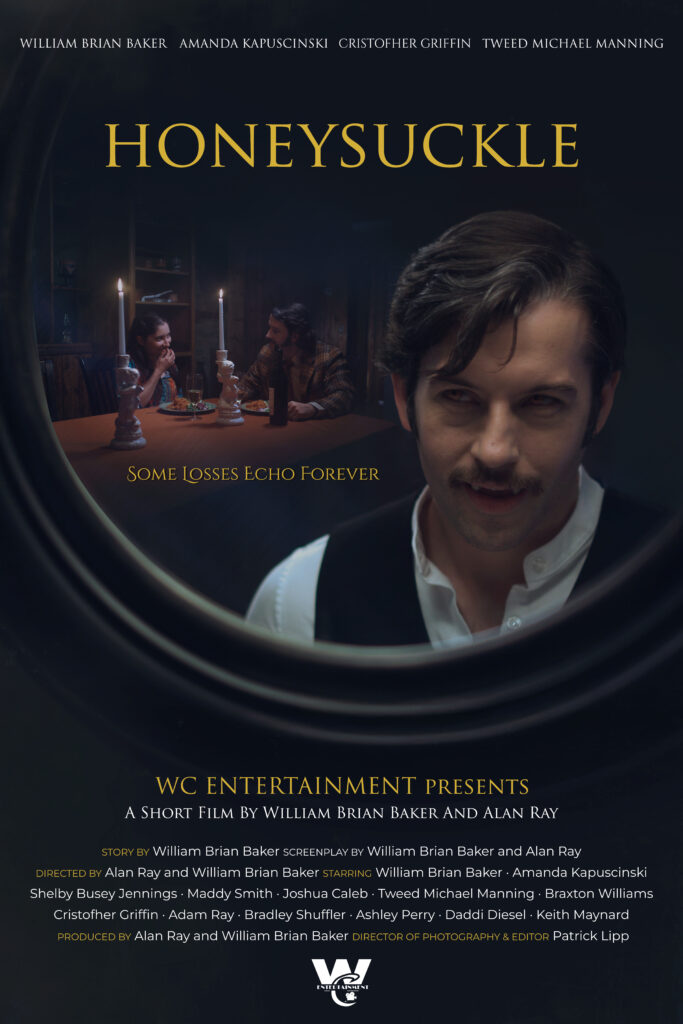
In the mid-1970s, a man shattered by the sudden loss of his wife honors her last wish by embarking alone on their honeymoon journey, only to face an unexpected transformation that dooms him to endless life. Decades later, adrift and invisible in a fast-moving world, he seizes a modern opportunity to suppress his bloodlust and finally belong, rising from obscurity to viral celebrity until the glare of fame exposes the fragile secret he’s carried for half a century.
SYNOPSIS
Honeysuckle is an intimate 40-minute drama presented in immersive 2.39:1 CinemaScope, that follows Craig Mason, a man whose ordinary life in the 1970s is upended by profound grief when he tragically loses his young wife. Honoring her last wish, he travels alone to the honeymoon destination, arriving at the lowest point of his existence. In a moment of raw vulnerability, a fateful encounter in a shadowed alley changes him irrevocably—transforming him immortal. In a cruel twist of irony, the event grants his wish for his “journey to end” while simultaneously thrusting him into an eternity of grief and a hunger he must hide in the shadows, freezing him in time while the world races forward.
By 2026, Craig remains immortal yet carries decades of weight: he struggles to secure steady work, and isolation compounds his unrelenting bloodlust. Surviving on the margins, he discovers a clever, modern method that lets him manage his bloodlust without harm, finally enabling him to abandon the shadows for a life lived in the open.
When a perceptive podcaster discovers he’s immortal and draws him into her world of online curiosity, Craig’s life explodes: he emerges as “Honeysuckle,” the enigmatic influencer and global celebrity whose immortality captivates millions. His new identity sky-rockets him from the starving shadows to a life of mansions and supercars, becoming a miracle icon for a digital age, granting the belonging he’s craved since the 1970s. Yet as the spotlight sharpens, one unguarded moment risks unraveling everything, threatening to drag his carefully constructed existence back into the shadows. Craig realizes he has merely traded one form of isolation for another. He exists within a gilded cage of enduring pain, living eternally out of time—seen by millions but truly known by no one.
This character-driven drama strips away genre clichés to explore enduring grief, the alienation of being out of sync with time, the seductive dangers of sudden visibility in the digital age, and the human ache for a place to finally rest. In the end, Honeysuckle reveals a tragic irony: even amid the mansions and supercars of a miracle icon, a profound isolation endures—the silent burden of never being able to reveal the real reason he does not age, a truth no spotlight can reach. Honeysuckle is a poignant reminder that some losses echo forever, and celebrity cannot mend the fracture between who we are and who we must forever pretend to be.
DIRECTORS STATEMENT
As co-directors of Honeysuckle, Alan Ray and William Brian Baker approached this project as a deeply personal collaboration between two filmmakers with over forty-five years of multi-disciplinary production expertise. What began as Baker’s original story evolved through our joint screenplay into something far more intimate than any genre label: an examination of interrupted dreams, the weight of unending time, and the modern mythologies we construct around identity and belonging.
We drew inspiration from classic tales of isolation and existential despair, but deliberately subverted familiar tropes. Rejecting the vanity of eternal youth, we positioned the protagonist’s condition as a clinical metaphor for profound, unresolved grief and societal obsolescence. In a world obsessed with anti-aging, influencers, and viral fame, his “success” is the cruelest irony: he gains everything except the one thing he wants most, simply to belong. The satirical elements allow us to critique how quickly personal tragedy can be commodified in the attention economy, while centering the narrative on the quiet, enduring ache of the human heart.
Shot on a modest budget with an award-winning ensemble, Honeysuckle honors the collaborative spirit of independent cinema. We wanted to create a film that feels both timeless and urgently now, one that asks: What happens when loss doesn’t end, when fame can’t fill the void, and when the shadows you flee from are the only place left to hide?
We hope audiences leave haunted not by spectacle, but by the quiet ache of what might have been and the fragile line between being seen by millions and being truly known by no one.